Liquid barriers and bait station systems solve the same problem differently, and the structure usually decides. A liquid application fits when the foundation soil is reachable and you want the barrier in place now —…
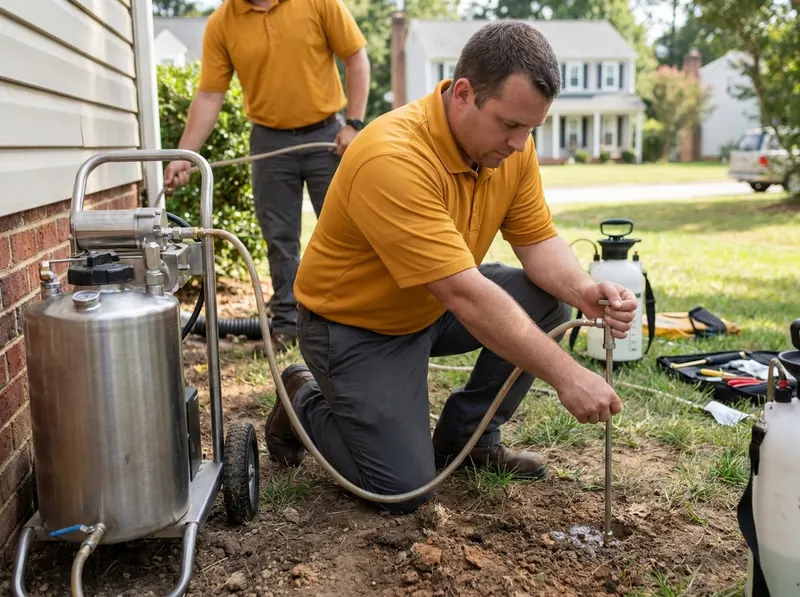
Liquid barriers and bait station systems solve the same problem differently, and the structure usually decides. A liquid application fits when the foundation soil is reachable and you want the barrier in place now — active eastern subterranean termite swarmers on a windowsill in April, mud tubes climbing a crawlspace pier, or a closing date on a Lakeside or Highland Springs sale. Bait systems make more sense when the perimeter is largely hardscape, when a well or cistern sits close to the foundation, or when a landlord wants monitoring stations checked on a schedule instead of a one-day soil treatment. The trade-off is honest: liquid gives you a barrier the day it goes in but disturbs mulch beds, monkey grass, and sometimes a patio slab that has to be drilled at 12- to 18-inch intervals and patched. Baits avoid the digging and drilling but work over months as foragers carry the material back to the colony.
Henrico's housing stock shapes the job more than the address does. The brick ranches around Lakeside, Dumbarton, and off Hungary Spring near the county government center at Parham sit over crawlspaces with accessible block foundations, which is close to ideal trenching — but many have added a concrete stoop, a converted carport, or a sunroom slab that has to be rodded or drilled separately or the barrier has a gap. Newer construction in Short Pump, Wyndham, Innsbrook, and Three Chopt is mostly slab-on-grade with poured patios and attached garages, so a bigger share of the footage becomes drilling rather than digging. In Varina and along the low, moist ground toward Osborne Boat Landing and the James, high soil moisture and heavy clay keep termite pressure steady, and we look hard at downspout discharge, splash blocks, and mulch piled above the brick weep holes. Older frame homes in Sandston and Highland Springs near Richmond International often have earth-to-wood contact at porch posts or a low crawl clearance that limits how much soil we can treat, and we tell you before we start which footage cannot be treated and why.
On safety, the termiticide goes into soil below grade and under concrete — not onto living surfaces, siding, or garden foliage. We measure a setback from vegetable beds and edibles, cover exposed soil until the trench is backfilled, and ask that pets and kids stay off the work line until the soil is replaced, usually the same afternoon. Central Virginia's calendar matters too: swarms run heaviest on warm afternoons after rain from March into May, which is when most Henrico calls come in, but soil work goes in year-round as long as the ground is not frozen. A liquid barrier does not stop conditions from rebuilding a bridge over it — regraded mulch, a leaking hose bib, or scrap lumber stacked against the crawlspace vent will invite termites right back, so the inspection report lists those items in plain language.
What you get in writing is the treated linear footage, the drill locations, the product used and its dilution, and any area we could not reach. Label rates for most soil termiticides call for roughly 4 gallons of finished dilution per 10 linear feet per foot of depth, so the volume applied is not a judgment call — it is measured, and we will show you the math on your foundation. Find the entry. Seal it. Stay gone.
Every job gets a firm, written price after a free on-site visit.
Tell us about your liquid termite barrier treatment job in Henrico and we'll send a clear, written quote — usually the same day.
 Pestoryx Pest Control