Three nest types account for nearly every stinging-insect call in Henrico, and each is a different job. Paper wasps build open, umbrella-shaped combs under porch ceilings, vinyl soffits and door frames — extremely…
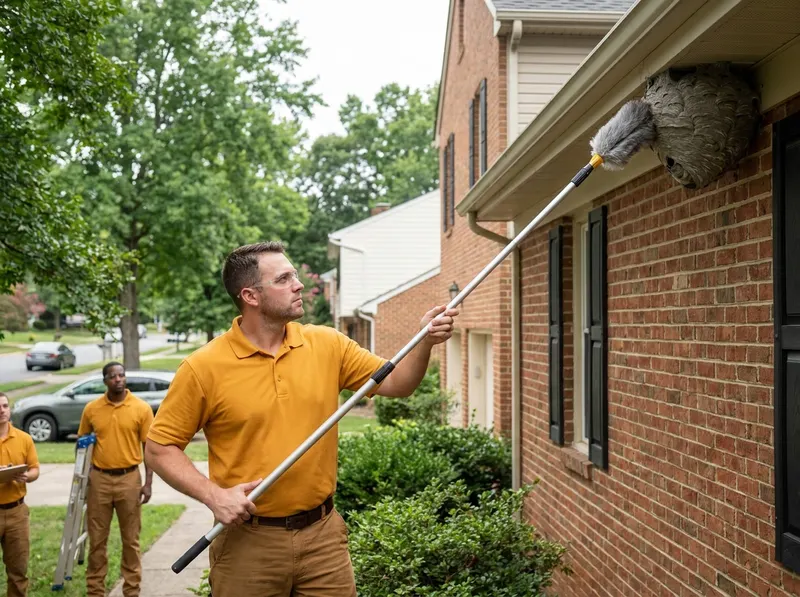
Three nest types account for nearly every stinging-insect call in Henrico, and each is a different job. Paper wasps build open, umbrella-shaped combs under porch ceilings, vinyl soffits and door frames — extremely common on the 1950s and 1960s brick ranches around Lakeside and Highland Springs, where the wasps tuck combs behind aluminum trim and inside storm-door channels. Bald-faced hornets build the gray, football-shaped paper nest people photograph and send us, usually 10 to 25 feet up in a holly, river birch or dogwood in newer subdivisions like Wyndham, Twin Hickory and the Short Pump corridor. Yellowjackets are the ground nesters: a single quarter-sized hole in a mulch bed, a slope, or a lawn seam, which is why so many Varina and Sandston calls start with a lawnmower or a string trimmer setting off a swarm. Yellowjackets also exploit gaps around brick weep holes and fascia and build inside wall voids, and that version needs a different approach than a nest hanging in the open.
Timing drives the difficulty. Queens start nests in April and May when the colony is small and one treatment is quick. Colonies peak from late August through the first hard frost, which in central Virginia usually arrives late October or into November, and a mature yellowjacket colony can hold thousands of workers by then. A September nest in the soffit above a Glen Allen garage door is a bigger, more defensive job than the same nest in May. That is not a scare tactic — it is the reason a late-summer nest sometimes needs a follow-up check while returning foragers die off over the next few days.
When does this service fit, and when does something else? Nest removal is the right call when you can point at a specific nest or a specific hole and the activity is concentrated there. A recurring general perimeter program is a better fit when wasps keep rebuilding in a dozen spots every spring — typical on houses with deep covered porches, open pergolas or wide vinyl soffit runs. The honest trade-off: nest removal solves the nest in front of you and does not stop a new queen from starting fresh next April in a different eave. There is also a real case for doing nothing. A bald-faced hornet nest 40 feet up a tulip poplar at the back of a Varina lot, well away from where people walk, will die out at frost and never be reused. We will tell you that on site rather than sell a treatment.
Safety questions get straight answers. Treatment is applied directly into nest openings and voids, not broadcast over vegetable beds or lawns, and we ask that children and pets stay indoors for a short window while the material settles. Nests over a doorway, near a pool, or beside an air handler get treated first for a reason. If anyone in the household has a known sting allergy, say so when you call — that changes how we sequence the visit. Pricing is set by nest type, height and access, so you hear a real number before work begins instead of a mystery quote after.
Every job gets a firm, written price after a free on-site visit.
Tell us about your wasp, hornet and yellowjacket nest removal job in Henrico and we'll send a clear, written quote — usually the same day.
 Pestoryx Pest Control