The Eastern subterranean termite is the insect behind nearly all termite damage in the Richmond area, and it enters from soil — never from the air. That single fact shapes how a Henrico inspection is run. In the 1940s…
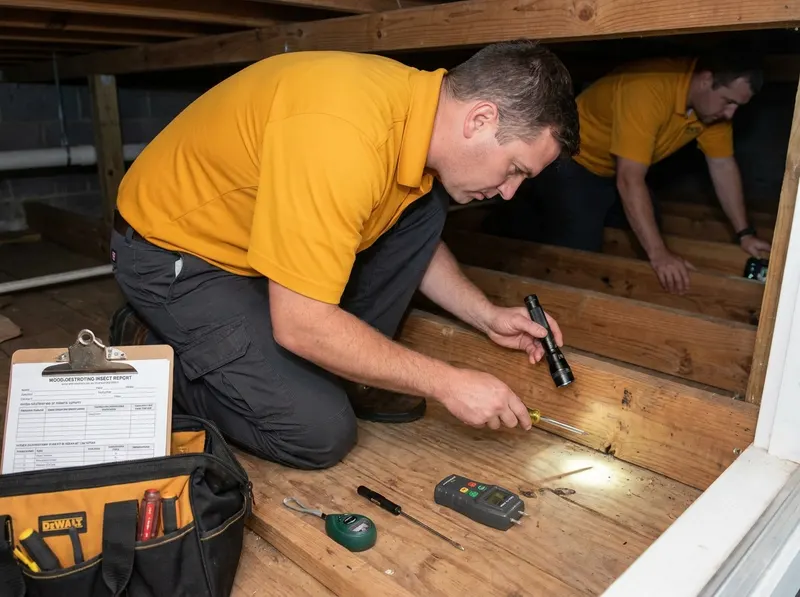
The Eastern subterranean termite is the insect behind nearly all termite damage in the Richmond area, and it enters from soil — never from the air. That single fact shapes how a Henrico inspection is run. In the 1940s and 1950s brick ranches through Lakeside and Tuckahoe, the crawlspaces are low, the piers are brick, and the first place to look is the sill plate and band joist above the foundation wall, where mud tubes climb out of the soil and follow the mortar joints. In newer slab-on-grade and poured-foundation builds around Short Pump, Wyndham and Three Chopt, the story is usually outside: mulch piled over the brick weep holes, irrigation heads soaking the siding, and stucco or foam trim carried below grade so the entry point is completely hidden from view. Frame homes in Sandston and Highland Springs often have older pier-and-crawl construction where powderpost beetle exit holes in floor joists are as common a finding as termites. Out in Varina, on the bottomland flats toward Osborne Boat Landing, high water tables keep crawlspace wood damp year-round, and damp wood is what draws both termites and wood-decay fungus.
Timing matters here. Swarmers show up on warm, humid afternoons from roughly March into May, and the call usually starts the same way: dozens of dark winged insects on a sunny windowsill or a pile of shed wings on the kitchen floor. Those swarmers are the reason spring inspection demand spikes across Glen Allen and Innsbrook. A swarm indoors means a colony is already inside the structure, and the report will say so plainly. Outside of swarm season, evidence is quieter — a hollow-sounding porch column, a pinhole line of mud on a garage block wall, or blistered paint on a door casing.
Decide between an inspection-only report and treatment by what you need documented. If you are buying, refinancing, or selling a home anywhere in Henrico County, the WDI report is the deliverable: it records what is visible on the date of inspection so the transaction can move forward, and it is a record of observed conditions, not a warranty or a guarantee against future infestation. If you already have live termites and simply want them gone, the inspection is still the first step, but treatment is separate work, priced separately by structure and linear footage after the entry point is identified. The trade-off is honest and worth stating: an inspection cannot see inside sealed walls, behind finished basement paneling, under stored boxes in a crawlspace, or beneath flooring, so inaccessible areas are listed as such on the form rather than guessed at.
Access drives both the price and the quality of the finding. Clear a path to the crawlspace hatch, unlock the garage and any outbuilding, and move stored bins off the perimeter walls before the visit. Where a crawlspace is too tight or too wet to enter safely, that limitation goes on the report in writing. Homes backing the wooded parcels near Deep Run Park and Dorey Park sit closest to buried stumps, downed limbs and old landscape timbers — the food source that supports colonies long before they reach a foundation, and the first thing we point out on the walk-around.
Every job gets a firm, written price after a free on-site visit.
Tell us about your termite inspection and wood-destroying insect report job in Henrico and we'll send a clear, written quote — usually the same day.
 Pestoryx Pest Control